
Custom Home Bars and Wine Displays in Jacksonville, FL

There is usually an awkward spot already doing the job: a console table with bottles on it, or a wine fridge sitting alone in a butler pantry. A custom home bar in Jacksonville, FL turns that corner into real cabinetry, and it is one of the custom cabinet builds we take on most often here.

Florida adds a wrinkle: heat and humidity are hard on wine, hard on cabinet finishes, and brutal on anything built out on a lanai.

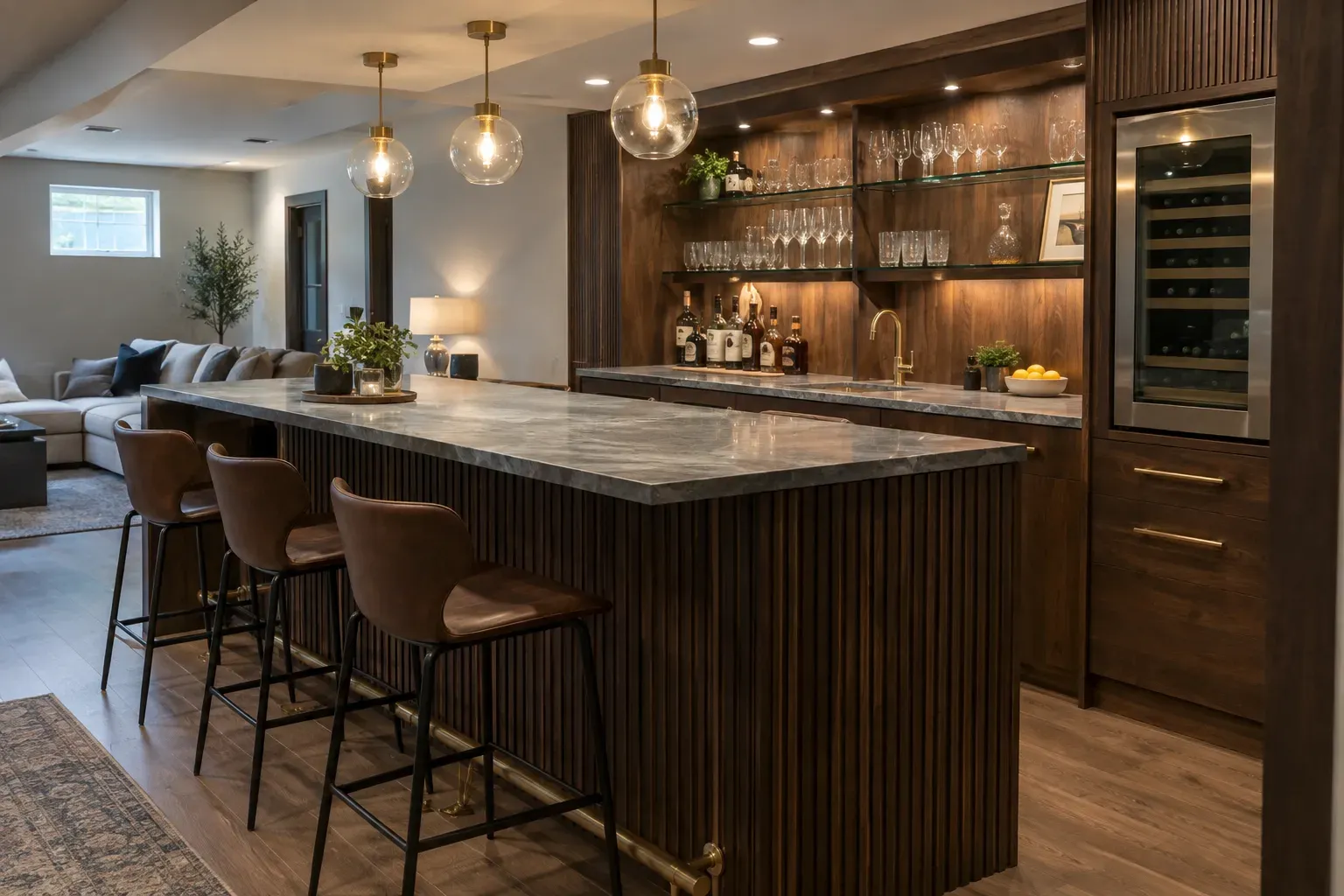
Walnut basement bar with a fluted island, gray stone counter, lit glass shelves and a built-in wine refrigerator

Wet Bar or Dry Bar: How to Decide

A wet bar has a sink and a drain. A dry bar does not. That one decision drives cost, timeline, permits and where the bar can go.

Dry bar Wet bar
Plumbing None Supply, drain and vent
Added cost Baseline Add $1,800 to $5,000
Permit in Duval County Usually not Usually yes

Choose a dry bar if the space is far from plumbing or the slab floor means a new drain requires saw-cutting concrete. Add an ice maker and a beverage fridge and you rarely miss the sink.

Choose a wet bar if you entertain often or are already opening walls, since plumbing is far cheaper when the drywall is down.

Built-In Home Bar Layouts and Sizing

A built-in home bar succeeds or fails on dimensions. Counters sit at 36 inches over 24-inch-deep base cabinets, and a raised ledge sits at 42. For stools, plan 12 to 15 inches of overhang and 24 inches per seat.

Depth matters in tight rooms. A 15-inch-deep bar still holds bottles and glassware, and we build plenty of these shallow runs.

The layouts that come up most:

  • Single-wall run. Base cabinets, counter, glass-front or open uppers, backsplash between.
  • Peninsula bar. Suits open-concept new builds, separating living from dining.

Undercounter appliances need planning, since each wants a dedicated circuit and airflow, and front-venting models are the only sensible choice in a built-in. Uppers are glass-front doors or open floating shelves.

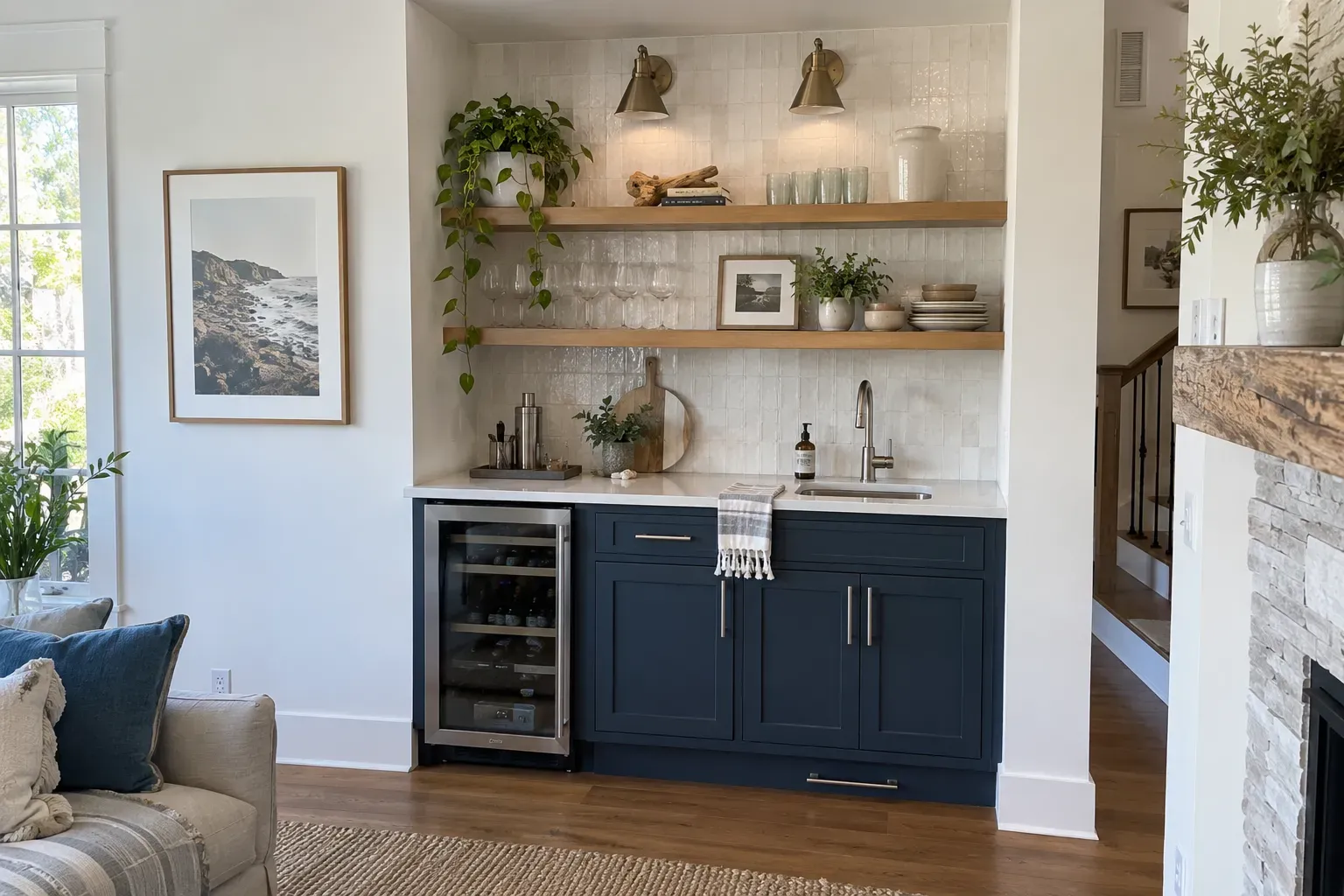
Navy shaker dry bar in a living room alcove with oak floating shelves, white tile backsplash and a wine fridge

Custom Wet Bar Cabinetry That Survives Humidity and Spills

Custom wet bar cabinetry lives a harder life than kitchen cabinetry. It gets splashed with things that are acidic and sugary, and it lives in a house that runs humid half the year.

Substrate first. We build bar boxes from plywood, never particleboard, and specify moisture-resistant panel near a sink.

Finish second. A sprayed catalyzed or waterborne conversion finish cures to a hard film that shrugs off a lime wedge and a spilled glass of red. Brushed latex looks fine on day one and shows rings within the year.

Then the details that stop damage early: we pan the sink cabinet floor, face the toe kick in PVC, and use stainless hinges and slides. Quartz is the counter workhorse, while marble etches the first time citrus hits it.

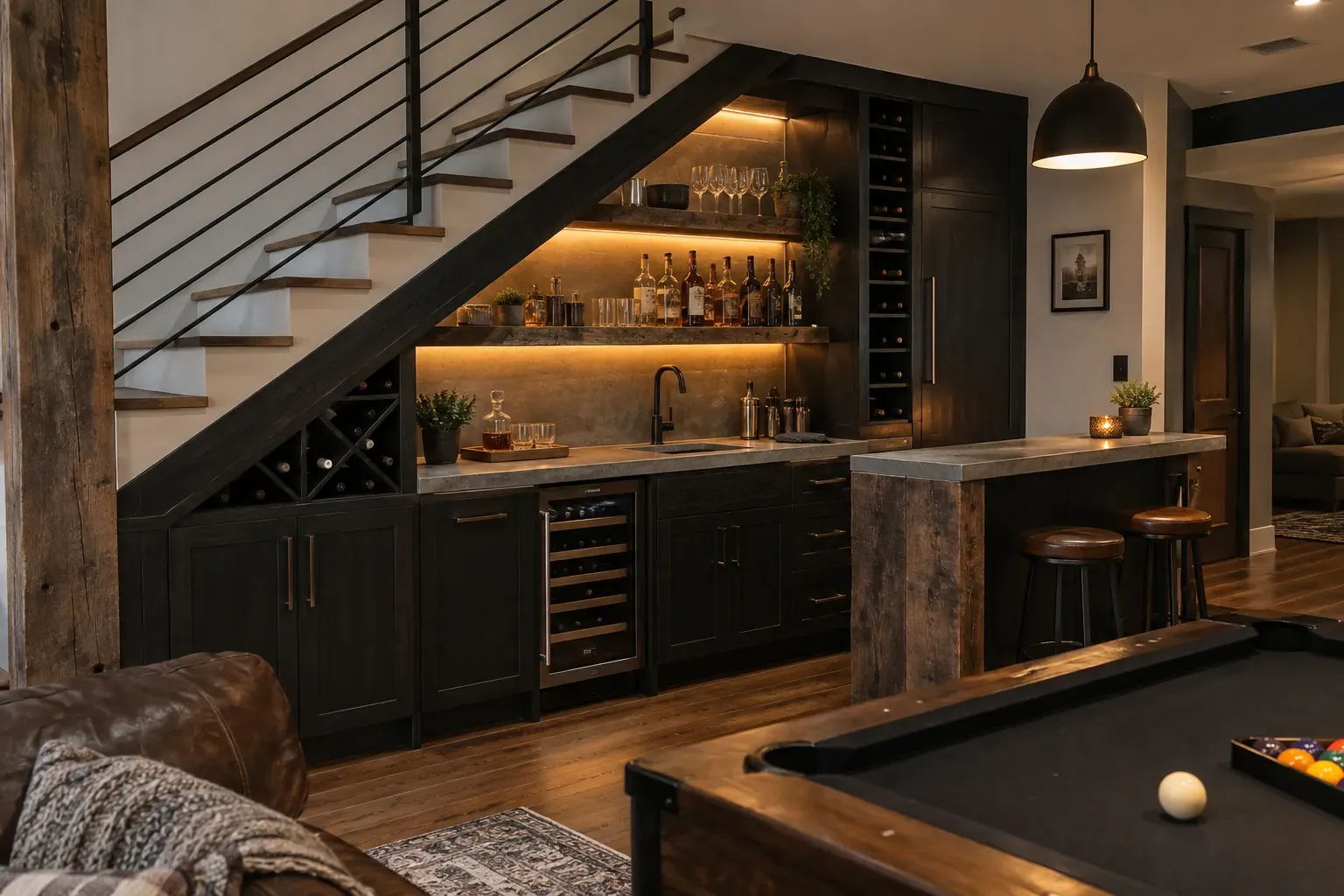
Dark under-stair home bar with lit liquor shelves, diagonal wine racks and a reclaimed wood bar counter

Custom Wine Displays That Work in a Hot Climate

Wine does not care about looking good on a rack. It cares about staying near 55 degrees, steady, away from light and vibration, and a Jacksonville house runs 74 to 78.

So every custom wine display we build falls into one of two honest categories. Display only is for bottles you will open within a few months: any rack, any temperature, because the wine is not living there long enough to cook. That is the right answer for most homeowners and costs a fraction of the alternative.

Conditioned storage is for bottles you are aging. That takes an insulated, vapor-sealed enclosure with a dedicated cooling unit, not just a pretty cabinet. The vapor barrier is what people skip, and in Florida humidity, skipping it means condensation inside your wall.

The practical middle ground is a hybrid: a conditioned undercounter unit for the keepers, plus open racking for everything else. Store bottles on their side so the cork stays wet, and never put racking where afternoon sun lands on the glass.

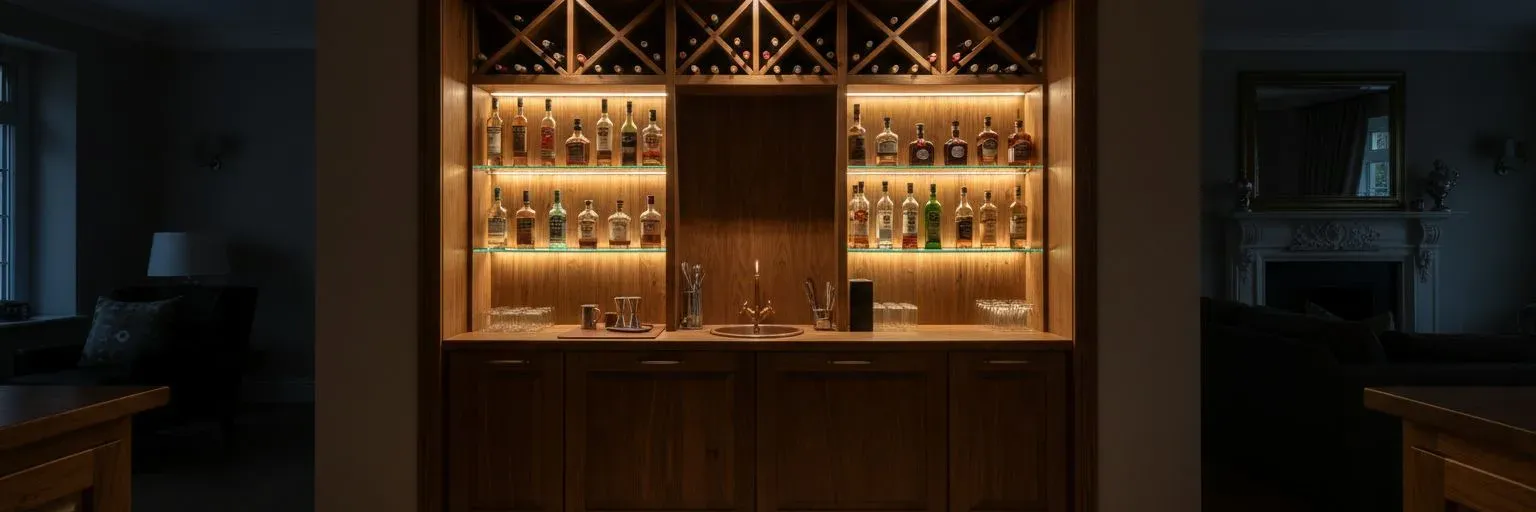
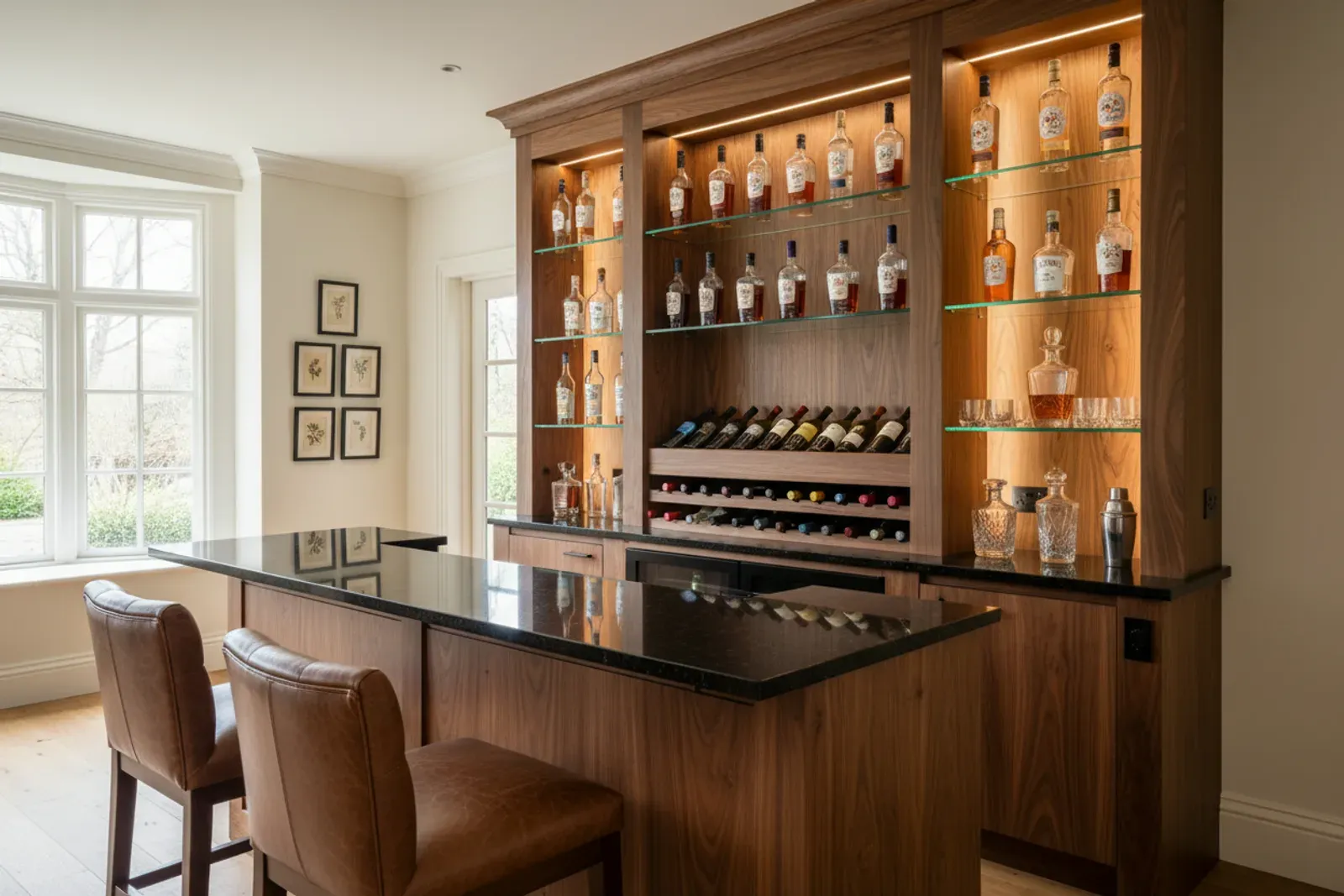
Home bar with a wooden back bar, glass shelves and bottle display

Wine Wall Designs and What They Cost to Run

A wine wall is the showpiece version: a floor-to-ceiling run of bottle storage, lit from behind or above.

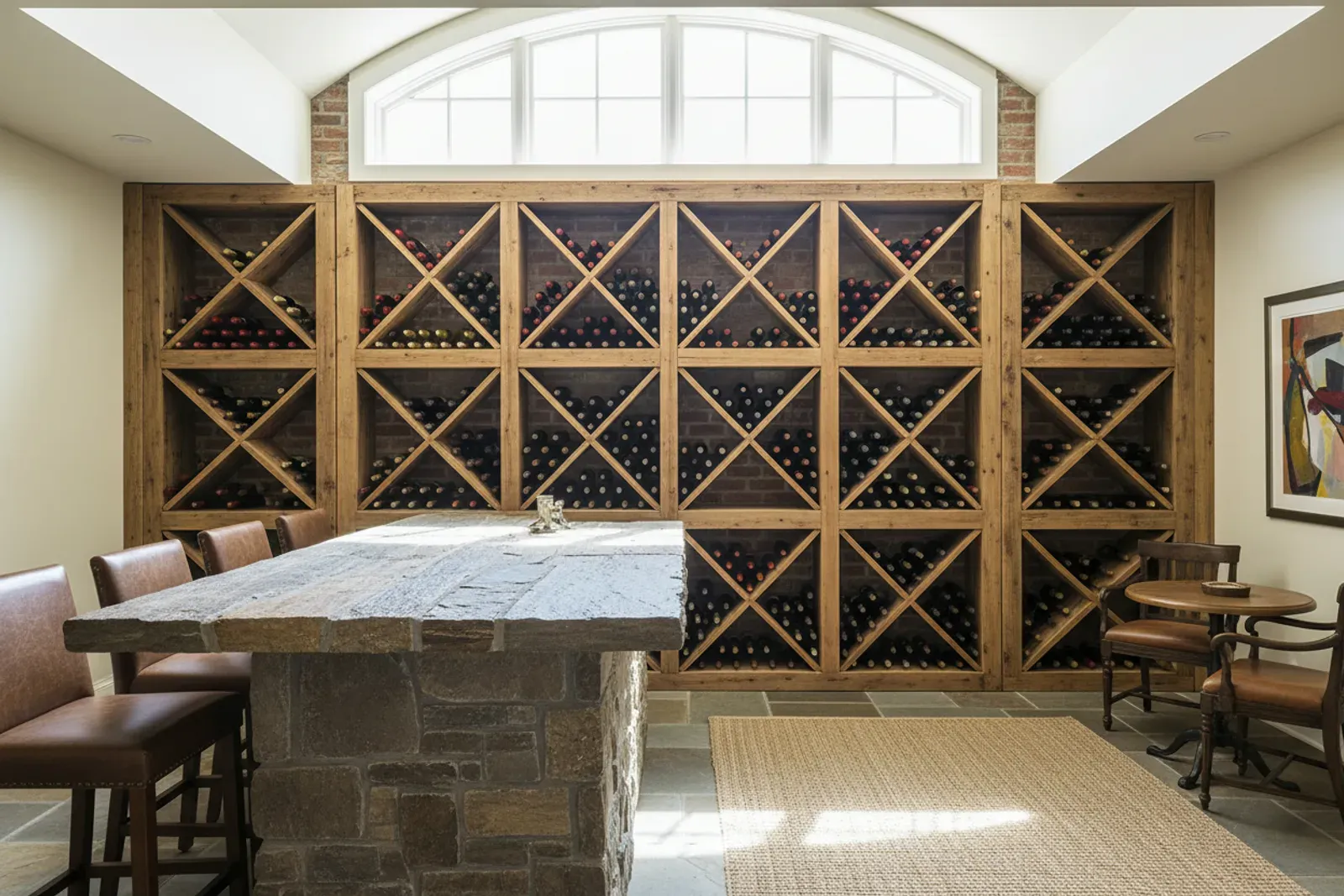
Cable and rod systems hold bottles on stainless posts, which looks modern and works well unconditioned. Wood racking in mahogany or white oak reads warm and is the standard inside conditioned rooms.

A conditioned wall is a whole assembly: closed-cell insulation, a continuous vapor barrier on the warm side, an insulated glass door, and a cooling unit sized to the volume with somewhere to dump its heat. A self-contained unit exhausts hot air into the next room, so a small closet is a poor neighbor.

We light nearly every wine wall with low-voltage LED tape behind a lens, the same detailing as our integrated LED lighting and millwork.

Basement bar with a stone counter and a wine bottle lattice

Lanai and Covered Outdoor Bars

Jacksonville lives outside most of the year, and covered lanai bars are a frequent request. They are also the easiest project to get wrong, because indoor cabinetry put outside fails fast.

Material Outdoor performance Notes
Marine polymer or HDPE Excellent Never rots, higher cost
Cellular PVC Excellent Paintable, good for bar fronts
Cabinet plywood Poor Delaminates within a season

We build outdoor carcasses in PVC, polymer or aluminum, never cabinet plywood. Hardware goes stainless, and at Atlantic Beach and Ponte Vedra we specify 316 stainless rather than 304, because ordinary stainless still pits in salt air. Counters go stone or porcelain, appliances have to be outdoor rated, and any ceiling or beam work overhead gets exterior-rated material like our tongue and groove ceiling installs.

Older Homes, New Builds and Getting Services to the Bar

In older Riverside, Avondale and San Marco homes, the bar usually goes into an existing butler pantry, dining alcove or den. The challenge is plaster, out-of-plumb corners and undersized electrical, so we scribe cabinetry to the walls and plan on new dedicated circuits.

In block-wall homes, common in Jacksonville from the fifties through the eighties, running services is the real constraint, because you cannot fish wire through block. We usually build a shallow furred wall in front of the block, which gives a clean chase for supply, drain and wiring plus a flat surface to hang cabinetry on. Coming down from the attic is the other good option, and chasing the block itself is a dusty last resort.

In open-concept new builds nothing hides the bar, so it has to match the kitchen cabinetry line or contrast on purpose. If you are at framing, tell us, because blocking, drains and circuits cost almost nothing to add before drywall.

Working With a Home Bar Builder, Start to Finish

Choosing a home bar builder should be straightforward. We start with a walkthrough: what is behind the wall, where the nearest plumbing and panel are, and how you entertain. Then you get a layout and a written quote with cabinetry, counter, appliances and finish itemized, plus a 3D rendering on bigger builds.

Once approved we sequence the trades: rough-in, drywall or furring, cabinet installation, then counter templating, usually the long pole at one to three weeks. Last comes backsplash, appliances, lighting, hardware and caulk, and we walk the finished bar with you. A dry bar takes two to three weeks start to finish, a full wet bar four to eight.

What a Custom Home Bar Costs in Jacksonville

Bars vary more than anything else we build, because appliances and stone can equal the cabinetry cost. These are typical ranges, and an exact number requires seeing the space.

Scope Typical installed range
Shallow dry bar, 5 to 6 ft, painted $3,500 to $7,000
Dry bar with beverage fridge and stone $7,000 to $14,000
Wet bar with sink and appliances $12,000 to $28,000
Conditioned glass-front wine cabinet $9,000 to $25,000
Covered lanai bar, outdoor rated $12,000 to $30,000

Three things move the number. A sink is the biggest swing, since plumbing in a slab home means concrete work. The appliance package is next, because a good ice maker and dual-zone wine unit add thousands on their own. Counter material is third, where a remnant and a bookmatched slab are different worlds.

What Sets Klein Carpentry Bars and Wine Walls Apart

Panned Sink

Cabinetry Made for Spills and Sticky Hands

Bar cabinets take more abuse than a kitchen run: citrus, sugar, red wine and a house that stays humid half the year. We build the boxes from plywood rather than particleboard, use moisture-resistant panel near the sink, and spray a hard catalyzed or waterborne finish that resists rings. The sink base gets a pan, the toe kick is faced in PVC, and hinges and slides are stainless so a small leak never turns into a swollen cabinet.

55 Degrees

Honest Advice on Storing Wine

Wine wants a steady temperature near 55 degrees, and most homes here sit in the mid to high seventies. We tell you plainly whether your bottles need conditioned storage or simply a good-looking rack for wine you will open soon. When aging is the goal, we build an insulated enclosure with a continuous vapor barrier and a cooling unit that has somewhere to send its heat, because skipping the barrier invites condensation inside the wall.

Salt-Air Ready

Lanai Bars Built From Exterior Stock

Indoor cabinetry moved onto a covered patio falls apart quickly, and cabinet plywood can delaminate in a single season. For outdoor bars we build the carcass in PVC, marine polymer or aluminum, top it with stone or porcelain, and choose outdoor-rated appliances. Near the ocean in Atlantic Beach or Ponte Vedra we step up to 316 stainless hardware, since ordinary 304 still pits in salt air. Even a screened lanai gets treated as fully exterior.

What Jacksonville Homeowners Say

4.8from 51 Google reviews

  • The level of quality Klein Carpentry has is next level. Their service is incredible and are very responsive and knowledgeable. They do all kinds of work. Highly recommend them for any projects you may have coming up!

    Vladimir Orgunov · 4 months ago on Google

  • Very professional and high quality work. Done a wonderful job with the mantle, floating shelves, ship lap, crown and base board! Totally recommend if you’re looking to finish up a home project.

    Alec Lambert · 11 months ago on Google

  • I reached out to get an estimate on building a wet bar to put in the mudroom of our home. Ray sent me a work up and it looked great, so we moved forward. Their craftsmanship is flawless, and they truly went above and beyond to ensure we were happy with the work. Would highly recommend if you’re looking at home projects

    Josh G · a year ago on Google

Reviews from Google

Frequently Asked Questions

Do I need a permit for a wet bar in Jacksonville?

If you are adding a sink, a drain or new circuits, you generally need a permit in Duval County. Dry bars with no new plumbing usually do not.

Will wine store safely in a bar that is not refrigerated?

For bottles you will open within a few months, yes. For anything you plan to age, no, because a Jacksonville house sits well above the low fifties year round. The usual answer is open racking plus a conditioned undercounter unit for the keepers.

Can you convert our butler pantry into a bar?

Often yes, and it is good value because power and plumbing are usually close by. We rework or replace the cabinetry, add appliances and a counter, and finish it as a bar.

Can a home bar be built on a lanai in Florida?

Yes, as long as it is built with outdoor-rated materials from the carcass out: polymer, PVC or aluminum instead of plywood, stainless hardware, stone counters. Under a screen enclosure you still get wind-driven rain, so we treat a covered lanai as fully exterior.

How do you run plumbing and wiring through concrete block walls?

Most often we build a shallow furred wall in front of the block, which creates a clean chase for supply, drain and wiring without cutting the structure. Other times we come down from the attic.

Related Cabinet and Carpentry Services

Let Us Look at the Space

Send a photo of the wall or the lanai and we will tell you what is realistic there. Call Klein Carpentry at (904) 759-4988 for a walkthrough anywhere in Jacksonville.

Get A No Cost Quote Today